
Baby Development
Developmental milestones are behaviors and physical skills children reach and master as they grow. Some first-year-of-life physical milestones include:
- Rolling over
- Reaching for objects
- Sitting up
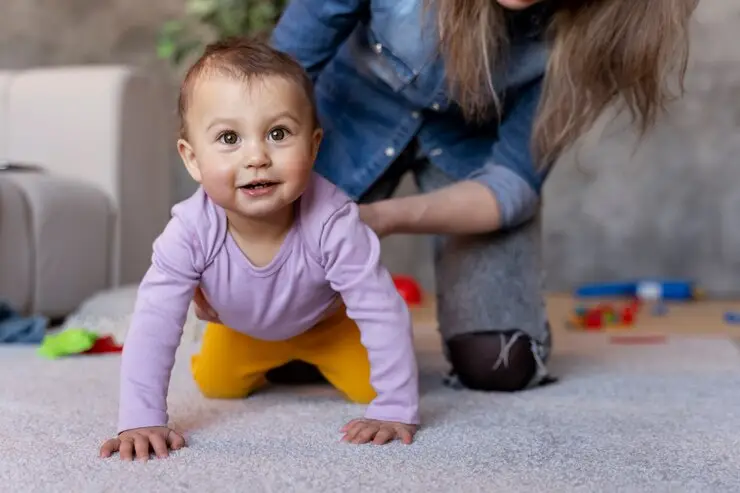
- Crawling
Behavioral/social milestones include mimicking your expressions and crying or laughing to show emotions.
Here are the milestones you can expect during your baby’s magical first year of life!
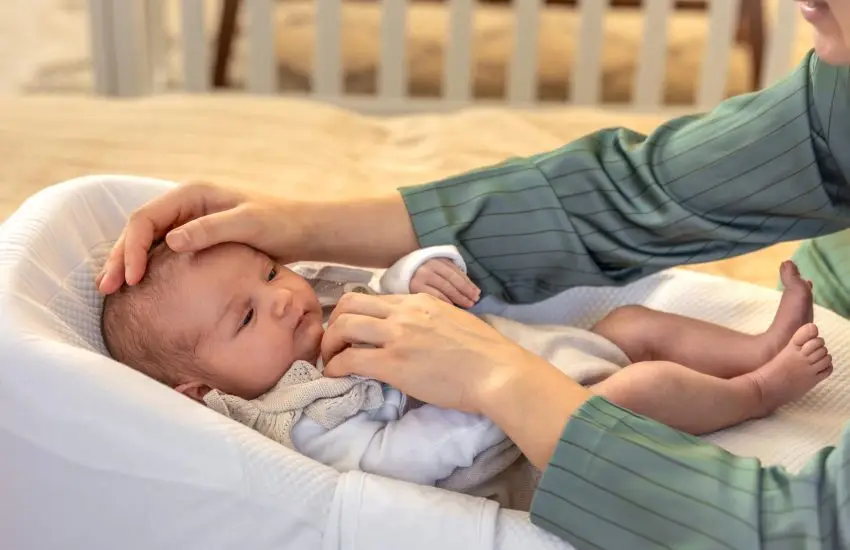
First month
It may seem that your baby is simply an eating, pooping, and sleeping machine at this point. But a lot is going on in that tiny body. Milestones to watch for include:
- bringing hands and fists toward mouth (though not always with great accuracy)
- developing reflexes — flinching at loud sounds, shutting eyes at bright lights
- focusing on objects brought within 12 feet of their face
- turning toward familiar sounds and voices — like yours!
Second month
Your baby is starting to act, well, more baby-like. By the end of 2 months, your baby is likely to be:
- Gurgling/cooing
- Trying to follow movement with their eyes (called tracking), although it may not seem very coordinated
- Holding their head up and pushing upward with their arms while lying on their tummy
Third month
Your baby is progressing from dependent newborn to more independent baby (yay — you might find those 5 minutes to take a shower!). This is when some of that cuteness overload starts to kick in. Watch for:
- Smiling at the sound of your voice (pro tip: record this and review in 15 years to prove that there was once a time your child liked you)
- Holding their head and chest up and kicking their legs when lying on their stomach
- Grasping toys
- Putting their hand in their mouth with more precision
- Making more vowel sounds (ooh and ah)
- Recognizing familiar faces and objects from a distance
- Trying to imitate your facial expressions
Fourth month
At this stage, your baby is taking the milestones already achieved and perfecting them. For example, they may hold their head up more consistently and for longer periods, grasp toys with more coordination, and copy your expressions with more accuracy. Other milestones are:
- Holding a rattle and shaking it at the same time
- Perhaps starting to roll from tummy to back
- Tracking movement more fluidly
- Pushing down on legs when held in standing position
Fifth month
Your baby continues to grow, explore, and master. As their strength and coordination increase, you may notice that your baby is:
- Rolling from tummy to back and then back to tummy
- Grabbing their feet, and maybe even inserting them into their mouth
- Moving objects from one hand to another
- Showing interest in the food you’re eating, a sign they’re getting ready for solid foods
Sixth month
Your baby’s growing up! They may now be:
- Sitting up briefly without any support
- Saying consonant (mmmm) and vowel (eeee, ooooo) sounds
- Playing and expressing displeasure when playtime stops (keep those raspberries coming!)
- Trying to get things out of reach
- Recognizing their name
- Expressing emotion (by crying or whining when sad or angry and laughing or squealing when happy)
Seventh month
Your baby continues to build on what they’ve already learned. Milestones include:
- Sitting up without support for longer periods
- Responding to the word “no”
- Recognizing emotions (happy, stern, etc.) by your tone
- Using their hand like a rake to reach for something (called the “raking grasp”)
- Responding to expressions — smiling at a smiling face, looking uncertain at a fearful o
- Tracking objects more smoothly
- Stringing more consonants together while babbling
Eighth month
You might notice that your little one can now roll over, sit up, and move objects from hand to hand or hand to mouth like a pro. You might also begin to see your baby:
- Rocking back and forth on their hands and knees or scoot along the floor
- Pulling up to a standing position
- Drooling — a lot (some babies will be cutting their first teeth around this age)
- Continuing to babble (was that a random ma-ma or da-da you just heard?!)
- Developing stranger or separation anxiety — this is a kind of distress babies feel when they’re separated from their parents or primary caregivers.
Don’t worry — separation anxiety passes. We promise you’ll eventually be able to go to the bathroom alone again.
Ninth month
Your baby is on the move! They may be:
- Crawling
- More confidently pulling up to a standing position
- Playing peekaboo or looking for an object you’ve hidden
- Using the pincer grip (which involves holding a small object like a piece of cereal or pasta between their forefinger and thumb)
- Pointing at things they want.
Tenth month
Your baby conintues to explore and experiment. Watch your baby as they’re:
- Moving from pulling to stand or crawling to “cruising,” or walking while holding on to furniture or objects around a room
- Banging objects together just to hear the sound they make — a kind of auditory assault rivaled only by your neighbor’s garage band
- Poking at things
- Putting objects into a container and then taking them out again
- Feeding themselves finger foods
- Shaking their head “no” and waving “bye-bye”
Eleventh month
In addition to reaching, crawling, and cruising, your baby may be:
- Continuing to explore language, giving you more mamas, dadas, and maybe even the occasional uh-oh! using the right inflection
- Understanding simple declaritive statements, such as “don’t touch”
- Copying your behaviors, like pushing buttons on a play phone and babbling to mimic converation
Twelfth month
Congratulations! You officially have a toddler, and you’re no worse for wear — except for maybe that time your baby gave your hoop earring that really bad tug and… well, we digress.
During their twelfth month, your baby will likely be:
- Standing briefly unsupported, and maybe even taking a step or two
- Exploring objects by banging, throwing, and dropping them
- Saying one or two simple words, such as hi, no, and bye
- Using objects correctly, if not clumsily (for example, using a spoon to eat and a comb to brush hair)
- Looking to the right object when you say, “Where’s the dog?” or “Where’s grandma?